

















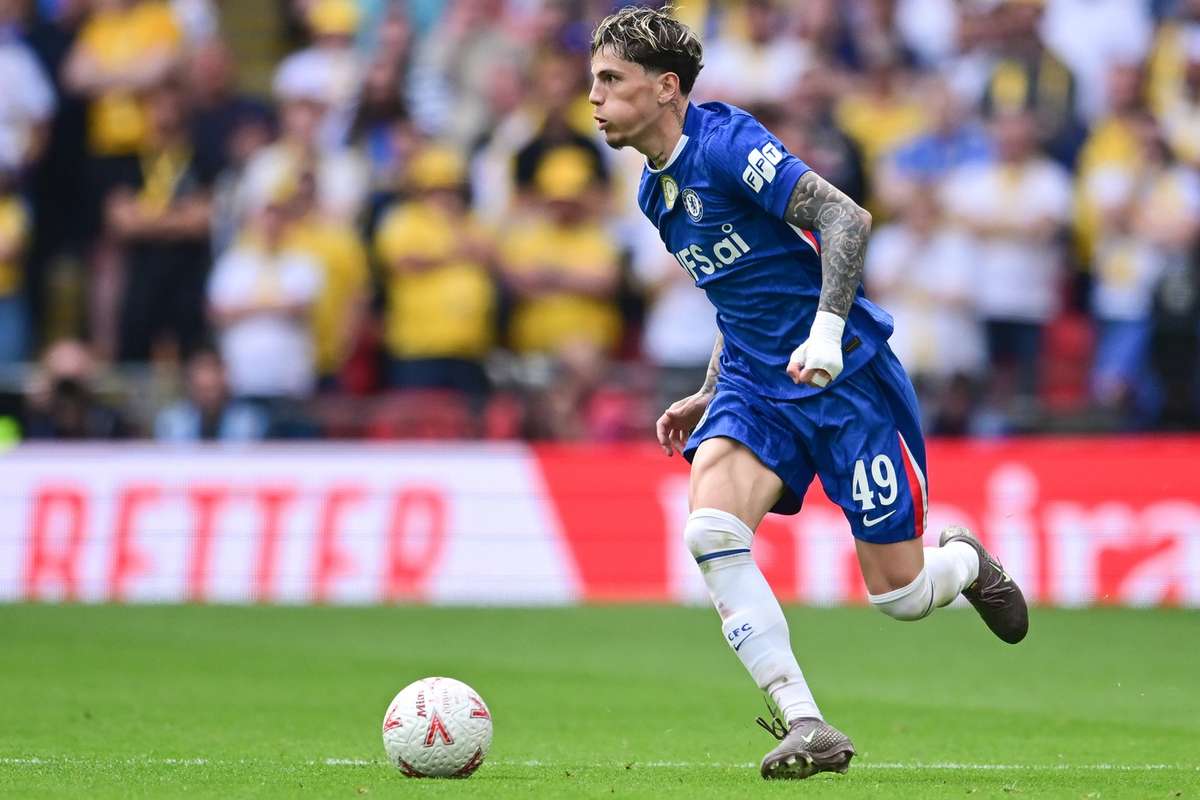
Alejandro Garnacho arrived at Chelsea as a player who had already shown he could deliver on the biggest stages. Under Erik ten Hag at Manchester United, the Argentine winger produced moments that defined seasons: a spectacular strike at Everton that ranked among the Premier League’s best, and the opening goal in the 2024 FA Cup final as United lifted the trophy against the odds. Those highlights suggested a forward who could bend tight games with direct running and composure in the box.
The problem for Chelsea is not whether Garnacho has talent. It is whether his profile, usage pattern, and fit inside a reshaped squad justify the cost of keeping him when playing time, attitude questions, and structural incentives all point toward a move.
Ten Hag’s Project vs. Amorim’s Reset
At Old Trafford, Garnacho’s rise tracked closely with ten Hag’s trust. The Dutch coach publicly backed the youngster, tied him to a long-term contract, and built part of United’s wide attack around his willingness to attack space off the left. That alignment mattered: Garnacho’s best work came when a manager wanted him on the ball in transition and accepted the volatility that comes with high-risk wing play.
Once Ruben Amorim replaced ten Hag, the relationship changed quickly. Garnacho was soon linked with United’s so-called bomb squad, the group of players effectively frozen out of first-team plans. The exact reasons were debated, but the football outcome was clear. Amorim did not build his system around Garnacho, and a player who thrives on rhythm and repetition cannot manufacture form from sporadic appearances and public uncertainty.
Chelsea initially looked like a reset that suited both sides. The Blues needed wide depth, Garnacho needed a club that would play him. On paper, the move aligned player need with squad construction. In practice, the same pattern reappeared: strong individual moments, limited sustained role.
The 2025/26 Numbers Tell a Narrower Story
Garnacho’s Chelsea output across 43 appearances in all competitions reads respectably on a spreadsheet: eight goals and five assists. Compared with his final United stretch, that production is broadly in line. The deeper issue is minutes and context.
Only four of those 43 outings lasted the full 90 minutes. Two of those complete games came in lower-leverage fixtures, including an FA Cup tie against Hull and a Premier League meeting with Wolverhampton Wanderers near the bottom of the table. That is not an indictment of the player on its own, but it is a usage signal. Coaches tend to extend full-match trust to players they rely on in tight games. Garnacho’s distribution of minutes suggests he was rotated, sheltered, or held outside the core matchday group for long stretches.
Within Chelsea’s 2025/26 attack, his combined goal-and-assist output was exceeded only by Cole Palmer, Pedro Neto, Enzo Fernandez, and Joao Pedro. Each of those four logged significantly more playing time. Garnacho was not failing in isolation; he was competing for impact in a crowded forward line without winning the minutes battle that usually precedes statistical separation.
One metric does stand out. Garnacho recorded 12 fast breaks, a measure of direct transitions from defense to attack. Only Neto, with 14, posted more on the squad. That figure captures Garnacho’s clearest on-ball value: vertical speed, aggressive carrying, and the ability to turn a loose ball into a scoring chance before defenses reset. The data supports the eye test from his United peak. The question is whether that single strengths the broader fit concerns.
Attitude, Availability, and Pre-Season Signals
Statistics never fully settle debates about professionalism or dressing-room fit, but Garnacho’s Chelsea chapter was rarely discussed without whispers about attitude and application. Even before the 2025/26 campaign ended and before Xabi Alonso’s appointment as manager, there were persistent questions about whether he would remain in West London.
Those questions have hardened into something more concrete ahead of the 2026/27 season. Garnacho has not been seen at Chelsea’s pre-season training as the squad prepares for the new campaign. Absence alone is not proof of a transfer, but in modern squad management, players outside the summer group are usually either negotiating an exit or already outside the sporting plan.
For a club operating under multi-club ownership and tight roster rules, carrying a high-salary wide player who is not in the pre-season cohort is poor capital allocation. Chelsea are not merely selling a disappointing signing. They are trying to recover roster flexibility, wage efficiency, and positional clarity before a new coaching staff defines its starting XI.
Why Roma’s Loan Structure Makes Football Sense
Italian outlets have linked Garnacho with AS Roma, where manager Gian Piero Gasperini is said to want a loan with an option to buy. The structure matters. A straight permanent deal forces Roma to price risk immediately on a player whose recent minutes profile is uneven. A loan with a purchase clause spreads that risk across competitive reps in Serie A and European football, giving Gasperini time to test whether Garnacho’s transition game travels to a league that punishes loose decision-making in wide areas.
Gasperini’s interest is tactically coherent. His systems have historically rewarded wingers who press with intensity, attack half-spaces, and combine quickly with a mobile No. 10. Pairing Garnacho with Argentina teammate Paulo Dybala is not sentimental lineup building. Dybala’s touch-and-move game can draw defenders inside, creating the kind of one-on-one lanes where Garnacho’s pace becomes a weapon rather than a speculative dribble.
Roma are also monitoring Strasbourg winger Diego Moreira, another player under the Clearlake Capital umbrella. That parallel is instructive. Multi-club groups often use internal player pathways the way traditional clubs use feeder arrangements: move talent to environments where minutes and role clarity improve development or resale value. Whether Clearlake prefers a loan or pushes for a straight sale, the underlying logic is the same. Garnacho needs a defined role more than he needs another ambiguous bench seat.
Chelsea’s Incentive to Move On
From Chelsea’s perspective, offloading Garnacho is less about admitting a transfer mistake and more about applying basic squad arithmetic. Wide positions at Stamford Bridge are congested. Palmer’s central influence already reduces the need for a second high-usage creator on the flank. Neto, Fernandez, and Joao Pedro absorbed the minutes that translate statistical contribution into reliable match control. Keeping Garnacho without guaranteeing him a core role preserves a salary slot and a squad place that could go to a player better matched to Alonso’s planned system.
There is also a registration and harmony consideration. Modern Premier League squads operate under strict 25-man rules, UEFA list limits, and internal competition that can sour quickly when high-profile players train apart from the group. Moving Garnacho removes a recurring distraction and gives the coaching staff a cleaner message to the players who report for pre-season.
What Success Would Look Like in Rome
A Roma move is not a guarantee of redemption. Serie A’s defensive organization and Gasperini’s pressing demands will test whether Garnacho can convert burst speed into repeatable chance creation week after week. The loan option gives both clubs a sensible exit if the fit fails, and gives the player a platform if it succeeds.
For Chelsea, the wise play is to stop treating Garnacho as a sunk-cost puzzle and treat him as a roster-management problem with a clear solution. His best United moments proved he can matter in big games. His Chelsea minutes proved that talent without role security and buy-in from the manager erodes value fast.
If the Giallorossi proceed with a structured loan, Chelsea would likely be doing the player and themselves a favor: Roma gain a high-upside winger to pair with Dybala, Garnacho gets the minutes he has been missing, and the Blues recover the flexibility they need before the 2026/27 season takes shape. In a market obsessed with highlight reels, this is a decision grounded in something quieter and more durable: playing time, wage structure, and whether a player’s strongest data points still match the team building around him.