

















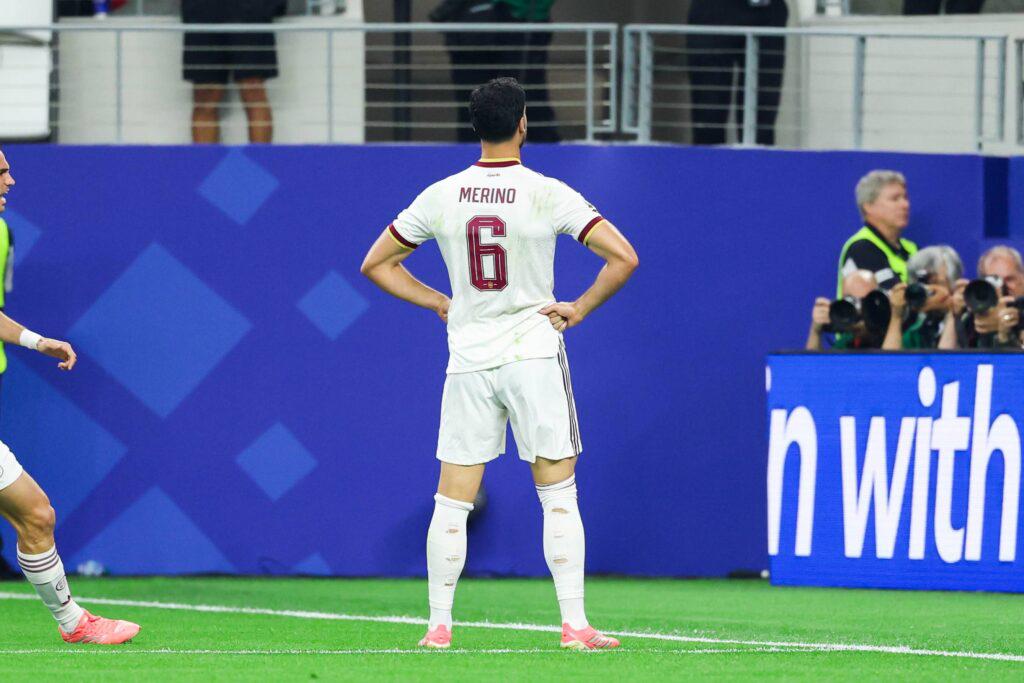
Spain's Round of 16 victory over Portugal at the 2026 World Cup did not unfold through sustained dominance or a flurry of chances. It came down to one late substitution, one composed finish, and a player who understood that knockout football often rewards precision over volume. Mikel Merino entered at AT&T Stadium in Arlington in the 85th minute and, within six minutes, had rewritten the tie with a goal in the first minute of stoppage time that sealed a 1-0 win for La Roja.
The assist came from Ferran Torres, who had entered the match earlier and provided the final pass. In front of 70,649 fans, referee Anthony Taylor kept firm control through extended stoppage time in both halves, and Spain — listed as the away side on the scoreboard — made the decisive moment count. For a player granted a brief cameo, Merino's influence was outsized. The numbers tell a story that a simple goal tally alone cannot capture.
One Shot, One Goal
Merino took exactly one shot. It was on target. It found the net. In a match where margins were razor-thin, that single attempt carried an expected goals value of 0.55 — a figure that already signals a genuinely dangerous chance rather than a speculative effort from distance. After contact, the shot quality rose further still, with an expected goals on target of 0.782, reflecting how well the strike was placed and how difficult it would have been for any goalkeeper to deny.
He needed only eight touches to change the direction of the tie. Two fouls won helped Spain manage the clock and relieve late pressure. He added one ball recovery to round out a cameo built on impact rather than involvement. The move for the winner was simple and sharp, finished without fuss. As knockout football so often decides, efficiency beat volume. A single action delivered the result.
That pattern — low touch count, high conversion value — is exactly what coaches hope for from a substitute in the closing stages. Merino did not need to impose himself across every third of the pitch. He identified the moment, executed cleanly, and let the scoreboard do the rest.
Clean Passing and Brief Control
In his 14 minutes on the pitch, Merino completed all four of his attempted passes. Two came in Spain's half and two in Portugal's half, showing calm use of the ball in both zones rather than a conservative retreat into safe territory. That split matters: a late substitute who only circulates in his own half can help run down the clock, but one who can retain possession in the opponent's half forces them to commit bodies forward and opens space for the decisive action.
He made two ball carries covering 35.23 meters in total distance. One progressive carry accounted for 25.61 meters, with his best forward push measuring 18.95 meters. Those carry metrics suggest Merino was not merely holding position — he was willing to advance the ball when the structure allowed it, contributing to Spain's ability to stay in an attacking posture even as the clock wound down.
In duels he won two and lost one, giving Spain second-ball stability late on. He was dispossessed once and officially lost possession once, a light turnover count for a substitute chasing control in a chaotic final stretch. His action values underline the narrative: shot value normalized at 0.49 outpacing both pass and dribble value, while defensive value checked in at 0.13 thanks to recoveries and contests. For anyone tracking micro-impacts, this is the kind of cameo that registers clearly in the underlying data even when the broadcast highlights focus on the celebration.
What the Metrics Say About Substitute Impact
Late-game substitutions are often judged by narrative — the fresh legs, the tactical tweak, the manager's gamble paying off. Merino's performance offers a more granular read. His expected goals total for the match nearly matched the quality of the chance he converted, which is rare for a player who sees fewer than 15 minutes. Most substitutes in tight knockout ties accumulate touches without generating high-value actions. Merino inverted that expectation.
The foul-winning component deserves attention as well. In a 1-0 environment with Portugal pushing for an equalizer, drawing two fouls is not a cosmetic stat. Each stoppage resets Portugal's rhythm, adds seconds to the clock, and forces set-piece organization that drains energy. Combined with his duel success rate and single recovery, Merino contributed to Spain's ability to absorb pressure without surrendering a transition moment.
His passing accuracy of 100 percent on four attempts is a small sample, but in context it reinforces the theme: no wasted actions. Every pass completed, every carry purposeful, every defensive engagement accounted for. That is the profile of a player who treats a cameo as a finite window rather than a gradual warm-up.
How It Fits His World Cup 2026
Zooming out to the broader tournament picture, Merino has now made five appearances and logged 141 minutes at the 2026 World Cup. His tally stands at one goal and zero assists, with three total shots and two on target across the competition. His cumulative expected goals sum sits at 0.70, which aligns neatly with a single converted strike — suggesting that his goal against Portugal was not an outlier in terms of chance quality but rather the moment his underlying threat finally translated to the score sheet.
Passing has been tidy throughout the tournament at 85.7 percent, consistent with the composed distribution he showed against Portugal. The Round of 16 goal may be the headline, but the underlying profile points to a midfielder who has been efficient whenever Luis de la Fuente has called upon him, even in limited minutes.
For Spain, the result advances them deeper into the knockout bracket with momentum built on defensive resilience and clinical finishing. For Merino, it reinforces a growing reputation as a player who delivers when stakes are highest — not through overwhelming statistical dominance, but through the kind of targeted, high-value contribution that decides ties when everything else has cancelled out.
The Bigger Picture for Arsenal and Spain
Merino's club form at Arsenal has long suggested a midfielder comfortable in physical, high-intensity environments. Translating that into a World Cup knockout stage winner — against a Portugal side capable of punishing any lapse — adds another layer to his profile. The goal itself will be replayed for years, but the data behind it tells a more instructive story: eight touches, one shot, one goal, and a cameo that changed the trajectory of a last-16 tie.
Knockout football rarely rewards the player who does the most. It rewards the player who does the right thing at the right time with the highest possible quality. On a night in Arlington where Spain and Portugal traded control without finding a breakthrough for 90 minutes, Merino needed six minutes to become the difference. That is not luck. That is the arithmetic of impact — and on this occasion, the numbers and the outcome pointed in the same direction.