










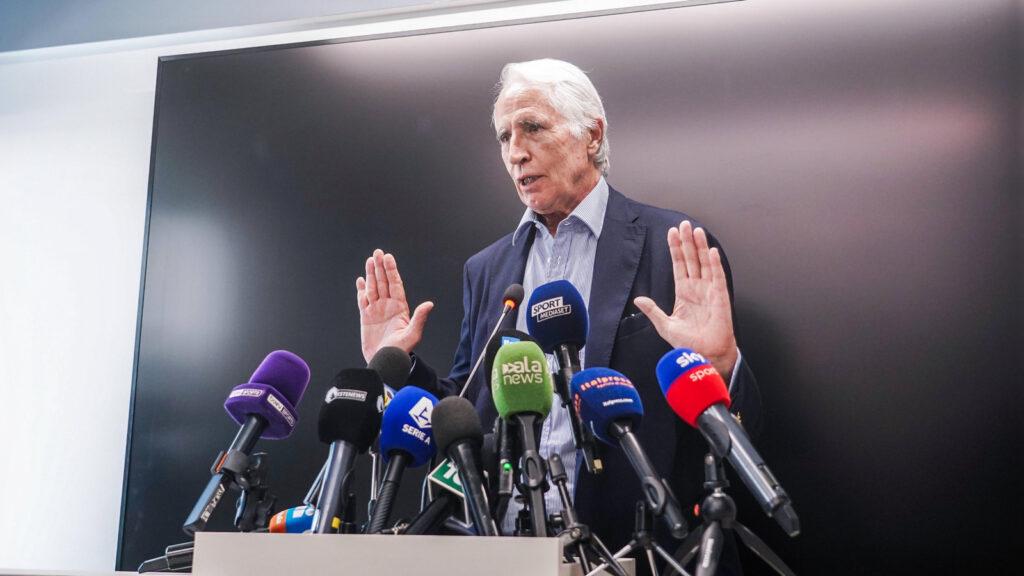
Italian football's latest administrative shock is not measured in goals or points, but in tenure length. Paolo Maldini and Leonardo informed FIGC president Giovanni Malagò that they are stepping down from their roles as technical director and advisor to the Azzurri, ending a partnership that lasted just over two weeks.
In federation terms, that is an unusually short runway. Most national-team rebuilds are framed in multi-year cycles: World Cup qualifying windows, Nations League blocks, and the 18-to-24-month planning horizon coaches use to embed systems. Maldini and Leonardo never reached that first planning checkpoint. Their exit signals that the underlying project collapsed before any on-field metric — possession structure, pressing triggers, squad age curve — could even be tested.
The Pirlo Pivot That Never Landed
The fracture traces directly to the breakdown of Andrea Pirlo's candidacy to become Italy's next head coach. Maldini and Leonardo had built their technical vision around the former midfielder as the on-pitch architect of a modern Azzurri identity. That alignment was logical on paper: Pirlo's playing profile mapped cleanly onto the possession-and-control model Italy has flirted with since the post-Conte transition, and his club experience offered a bridge between generational talent and tactical discipline.
Negotiations, however, stalled. Once Pirlo dropped off the Federation's radar, the organizational spine Maldini and Leonardo had sold internally — coach plus directors moving in lockstep — disappeared. Without that anchor, their mandate became a shell: a technical department asked to execute a blueprint whose central figure no longer existed.
From a decision-tree perspective, that is a hard stop. You cannot run a coherent scouting pipeline, staff hiring plan, or stylistic brief when the head coach slot reverts to an open variable. Maldini and Leonardo chose withdrawal rather than operate inside a structure whose first node had already failed.
What Two Weeks Buys — and What It Costs
Short executive tenures rarely produce tactical data, but they do produce governance risk. FIGC must now restart two parallel searches: a head coach and a reshaped technical department. Each day without a settled bench leader compresses preparation time for the next competitive window.
Consider the practical lag. A new coach typically needs weeks to evaluate personnel, align with federation staff, and define role profiles before the first camp. Italy's competitive calendar does not pause for administrative churn. Squad cohesion metrics — minutes shared between club pairs, positional stability, set-piece routines — depend on consistent messaging from the national setup. Repeated resets push those indicators backward.
The Conte and Mancini Benchmark
With the Maldini-Leonardo layer removed, familiar names re-enter the projection model. Antonio Conte and Roberto Mancini remain the most frequently cited coaching candidates, and for different analytical reasons.
Conte's track record offers immediate structural certainty: defined defensive organization, clear role assignment, and rapid squad buy-in. His Italy tenure already produced a measurable competitive spike — the unbeaten qualifying run into Euro 2016 and a deep tournament run — built on tactical clarity rather than experimental fluidity.
Mancini, by contrast, represents continuity with recent success. His Euro 2020 title shifted Italy's narrative from transitional side to champion, and his later cycle still left a squad core accustomed to a specific attacking rhythm. Reappointing him would minimize schematic drift, though it would also reopen questions about long-term evolution beyond that established framework.
Neither option resolves the technical-director vacuum on its own. That is where Giorgio Chiellini's name gains traction. His leadership profile — locker-room authority, defensive intelligence, federation familiarity — fits the modern director role that blends personnel management with cultural stewardship.
Institutional Instability as a Performance Variable
National teams are often analyzed through player form charts and club transfer noise. The FIGC episode is a reminder that front-office volatility is its own performance input. When the chain from president to technical director to head coach fractures within days, the downstream effects show up in selection consistency, camp scheduling, and the willingness of elite club coaches to release players into an unsettled environment.
Italy is not starting from zero on the pitch. The player pool still contains high-minute contributors across Serie A and top European leagues. The risk is not talent disappearance; it is project interruption. Without a settled coach-director pairing, the Azzurri lose the compound interest of a shared vision — the incremental gains that come when scouting, tactics, and squad rotation all point in one direction.
Where FIGC Goes Next
Malagò now faces a dual rebuild under public scrutiny. Appointing a head coach is the visible decision, but the deeper task is reconstructing a technical department credible enough to retain top candidates. Names will circulate; speculation is inevitable. What matters for competitive forecasting is whether the next pairing offers aligned incentives and a timeline measured in tournaments, not headlines.
Maldini and Leonardo arrived promising a coherent footballing identity anchored to Pirlo. Their resignations confirm that identity never materialized. Until FIGC stabilizes its leadership stack, Italy's on-field metrics will be judged against an off-field variable no xG model can fully capture: whether the federation can finish a rebuild it has now started twice in the space of a month.