

















There are mornings in Rotterdam when the Maas moves slowly and De Kuip feels less like a stadium than a gathering place — a roofed stretch of city where ambition is spoken aloud and old habits are treated as seriously as trophies. On one of those mornings this week, Feyenoord confirmed what the corridor talk had already suggested: Tjark Ernst is theirs.
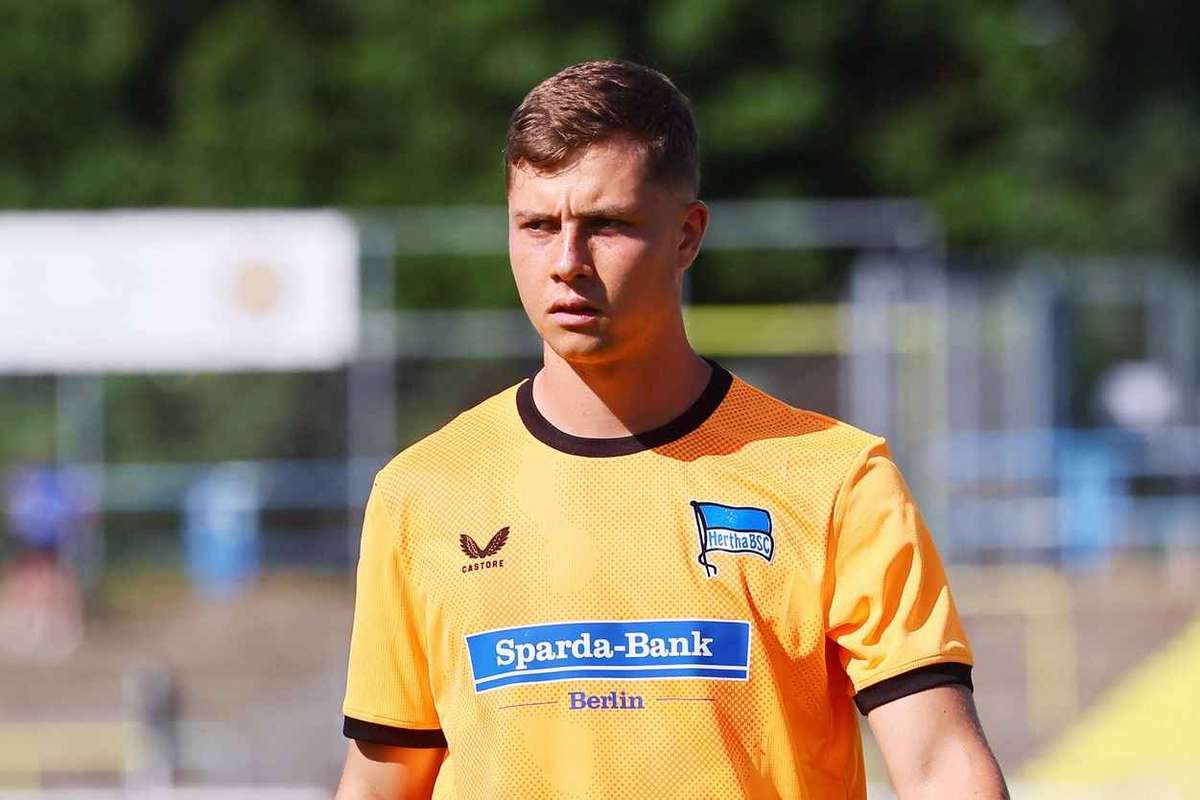
The 23-year-old German goalkeeper arrives from Hertha BSC on a four-year contract, the kind of commitment that tells you a club is not merely filling a vacancy but choosing a voice for a position that carries its own folklore. At Feyenoord, the goalkeeper does not stand apart from the crowd; he stands in front of it, and the crowd has long memories.
A Door Opens as Another Closes
The move had been building for some time. Conversations between Ernst and Feyenoord stretched across weeks, and by the time the agreement was reached earlier this week, the shape of the summer had already changed at De Kuip. Captain Timon Wellenreuther’s departure for Wolfsburg left more than a shirt number empty. It left a rhythm unsettled — the daily cadence of a starter who had become part of the club’s public face.
Into that space steps Ernst, not as a temporary answer but as the player the club expects to lead from the first whistle. Belgian-Irish keeper Liam Bossin remains in the squad, yet the hierarchy is clear: Ernst is the man Feyenoord want between the posts as European nights return and a refreshed coaching staff sets its tone.
That clarity matters in Rotterdam, where transitions are watched closely. Supporters do not merely ask whether a signing can save shots; they ask whether he understands what it means to wear the shirt when the ground shakes.
From the Second Tier to a European Stage
Ernst’s path to this moment runs through patience more than spectacle. He joined Hertha BSC from VfL Bochum in 2023 and went on to play 93 times for the second-tier side, three seasons of repetition, pressure, and the quiet education that comes from living week to week in a league where mistakes are not forgiven by spotlight, only by the next match.
“It’s wonderful to be able to call myself a Feyenoord player now,” Ernst said in his first comments through the club. “It felt right from the very first talks. The club has a lot of ambition, and that suits me.”
There is a particular tone in that sentence — not bravado, but alignment. Ernst is not selling a dream he has only just discovered. He is describing a fit he felt early, the sense that a club’s appetite and a player’s readiness were pointing in the same direction.
He was equally direct about the scale of the step. “After three years in the 2. Bundesliga, I feel ready for a move like this. It’s my first time outside Germany, to a big club that plays in European competitions every year and will be back in the Champions League next season.”
For a young goalkeeper, crossing a border for the first time is never only geography. It is language in the dressing room, tempo on the training pitch, and the nightly weight of a city that treats football as civic conversation. Ernst arrives with professional mileage, but also with the freshness of someone encountering a new football culture for the first time.
De Kuip and the Weight of Arrival
If you want to understand why this signing feels larger than a personnel change, listen to how Ernst talks about the stage itself.
“I can’t wait to take my place between the posts at De Kuip,” he said. “I know the European matches in particular are experienced with great intensity; Feyenoord is renowned for this not just in the Netherlands.”
De Kuip has never been a neutral venue. European evenings there carry a reputation that travels ahead of the team — the closeness of the stands, the noise that seems to bend toward the penalty area, the feeling that the ground itself participates. For a goalkeeper, that environment can either shrink the goal or expand it. Feyenoord are betting Ernst will grow into the former.
He also pointed to a ritual that belongs more to Rotterdam than to transfer paperwork: the club’s open day, when new arrivals have traditionally been introduced by descending into the stadium by helicopter.
“I’m really looking forward to making such an entrance at De Kuip by helicopter on Saturday and meeting the supporters for the first time,” Ernst said. “It can’t start soon enough for me.”
It is a theatrical entrance, yes, but at Feyenoord theatrics and tradition often share the same sentence. The open day is not only promotion. It is initiation — a first public test of whether a newcomer can carry the gaze of thousands before he has made a single save.
A Squad Still Taking Shape
Even with Ernst installed as the projected starter, the summer is not finished in the goalkeeper department. Feyenoord may continue searching for backup depth behind him, a reminder that modern squads are built in layers. Bossin’s presence offers experience and competition, yet the club’s long-term planning at the position now runs through the German.
That planning sits inside a broader reset. After the 2025-26 season, Feyenoord parted ways with manager Robin van Persie and turned again to Giovanni van Bronckhorst, a familiar figure returning to familiar ground. Change at the top often rewrites the mood of a squad, and Ernst’s arrival lands in that interval — early enough to be shaped by the new staff, late enough that he must arrive ready.
European Football Returns to the Calendar
Context sharpens every signing, and Feyenoord’s context this summer is unmistakable. The club are directly qualified for the league phase of the UEFA Champions League, a ticket that turns training sessions into preparation for nights when details decide seasons.
For Ernst, that is both opportunity and examination. Champions League football does not merely ask whether a goalkeeper’s hands are reliable; it asks whether his concentration survives the pauses, the tempo shifts, and the sudden cruelty of a single moment replayed across a continent.
Domestic duty arrives quickly as well. Feyenoord open their Eredivisie campaign on Sunday, August 9, against Sparta Rotterdam — a date that moves the conversation from presentation to performance. Helicopters and interviews give way to crosses, set pieces, and the first real question every new No. 1 must answer: what does he look like when the noise is not ceremonial, but competitive?
A New Voice in an Old Position
Transfers are often reported as lines on a page — club, player, contract length — yet at Feyenoord they are also chapters in a longer story about identity. The goalkeeper’s position here has always carried a slightly different burden, as if the job description includes remembering who came before and proving you belong after.
Ernst enters that lineage at 23, with second-tier endurance behind him and a four-year promise ahead. Wellenreuther’s exit created the opening; Van Bronckhorst’s return and Champions League qualification define the stage. What remains is the daily work — the training-ground repetitions, the communication with defenders, the small commands that turn a back line into a unit.
Saturday may bring the helicopter and the first wave of applause. Sunday, August 9, and the European autumn will bring the harder tests. In Rotterdam, arrivals are celebrated loudly, but careers are measured by what happens once the rotors fade and the stadium becomes a workplace again.
For Tjark Ernst, that workplace is now De Kuip. The contract is signed. The ambition is mutual. The season, with all its old intensity and new expectation, is waiting.