

















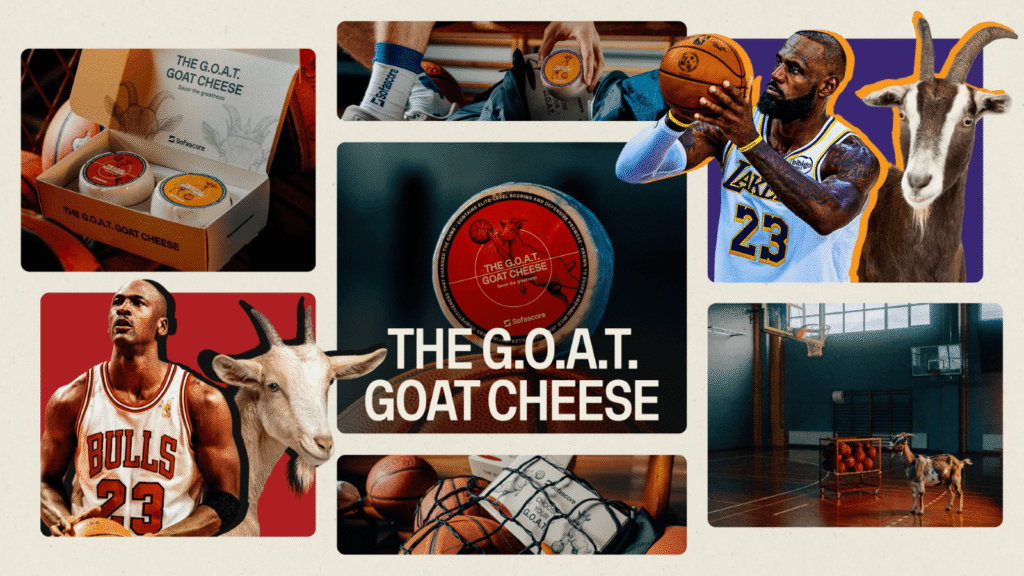
A goat cheese emblazoned with “Choose Your G.O.A.T.” has dragged a debate that has roiled basketball for decades—the greatest player of all time—from forums and bars onto supermarket shelves and short-form video. ScoreZ has rolled out two limited-edition cheeses, Mikey and Jamie, alongside an in-app vote that puts ten candidates on the same ballot: Michael Jordan, LeBron James, Kareem Abdul-Jabbar, Magic Johnson, Bill Russell, Kobe Bryant, Larry Bird, Tim Duncan, Nikola Jokic, and Stephen Curry. The cheese was never meant to settle the question, but it has certainly kept the argument going.
The “Greatest Ever” Debate in an Institutional Vacuum
In the context of professional sports governance, “GOAT” has never been a quantifiable metric in league bylaws. There is no unified weighting table to reconcile championships, peak statistics, era-level competition, and differences across rule eras; what leagues and data platforms can usually offer is a statistical framework and a place to argue—not a final ruling. Reporting on the story was blunt: a limited-edition cheese wheel was never going to end the debate, and that was never the product’s goal. The real issue is that when “greatest ever” lacks an official arbiter, commercial tie-ins and platform features naturally fill the vacuum of authority—whoever controls distribution channels helps define the boundaries of the conversation.
How the Content Industry Blows Up the Debate
On the U.S. side, creators embedded voting into existing traffic structures: RCR Trivia pitched the GOAT question to roughly 144,000 TikTok followers and tied it into ScoreZ; Halfpast_noon built full debate videos on YouTube; Makeshift linked story content directly to in-app voting; Worsttake Show put cheese at the heart of the show, wrapping basketball’s greatest divide in a “worst take” narrative. The debate did not stop at national borders—a Serbian basketball podcast seriously argued Jordan versus James for several minutes before pivoting to a third answer: Jokić, and the clip spread quickly; Croatia’s Paola Markek and Jan Mihaljević surfaced their picks for local audiences, connecting the “Mikey or Jamie” packaging hook to already opinionated fan communities. From a policy perspective, this is classic cross-border issue migration: the same marketing motif was localized and rewritten across different legal and cultural markets, with platforms supplying only the voting interface while interpretive authority scattered to creators and communities.
How product symbolism and the voting mechanism fit together
For readers who missed the first round of information, the campaign mechanism can be summed up as two parallel tracks: on the physical side, Mikey was described as “sharp and intense,” Jamie as “layered and long-lasting,” with packaging copy mapping cheese texture and flavor preferences onto the stylistic differences between “great players”; on the digital side, users voted for their GOAT from a ten-player list spanning basketball history inside the ScoreZ app (those named in coverage included Jordan, James, Abdul-Jabbar, Magic, Russell, Kobe, Bird, Duncan, Jokić, Curry, and others). Juxtaposing cheese and voting bound subjective taste (which you prefer to eat) to subjective basketball-history views (who you bow to) within one brand narrative—this does not constitute a ranking at the level of competition systems, but it does produce a statistically trackable distribution of preferences in user behavior, building interactive assets for the platform.
Implications for platform governance and fan participation
From an association and platform-governance standpoint, the boundaries of these kinds of co-branded campaigns deserve a clear-eyed line: first, entertainment products should not be read as authoritative historical rankings, so younger users do not mistake marketing votes for historiographical consensus; second, the emergence of a “third option” in cross-border spread (such as a Serbian podcast elevating Nikola Jokić) shows that even a globally unified candidate list gets reinterpreted through regional competitive context—if a platform only counts votes and does not explain its methodology, the numbers are easily quoted out of context; third, for data platforms, pairing ScoreZ’s existing match-data capabilities with socialized topics is a routine, compliance-friendly way to extend time on site, but the “vote ≠ verdict” warning must stay strong enough that it does not erode trust in serious discussion.
The professional read is this: the real output of this GOAT cheese marketing is not a dairy product that can prove whether Jordan or James is greater, but an observable, extra-institutional sample of public opinion—it turns the GOAT argument from static back-and-forth into an interactive module that is clickable, clip-ready, and replicable across borders. The practical tip for fans is equally direct: if you care whether your side is visible globally, vote in the ScoreZ app and follow how the topic develops; if you care more about historical rigor, go back to game tape, era rules, and full career data and compare for yourself—do not treat Mikey/Jamie on the shelf as an official league announcement.
In the short term, limited-edition cheese and the voting feature will keep feeding creators remix material, especially “local third option” clips; in the medium term, whether platforms can keep a transparent methodology between fun and seriousness will decide whether this kind of issue marketing builds brand equity or spends down the credibility of the debate. The basketball GOAT argument still has no final answer, but at least in this round its vehicle has shifted from pure text to something you can taste, screenshot, and spread across borders—products and buttons—which is itself a snapshot of how contemporary sports communication is changing.